Why Does IVF Fail? Common Reasons and What You Can Do Before the Next Cycle
11/14/2026 11:45:00 AM Lotus IVF Team
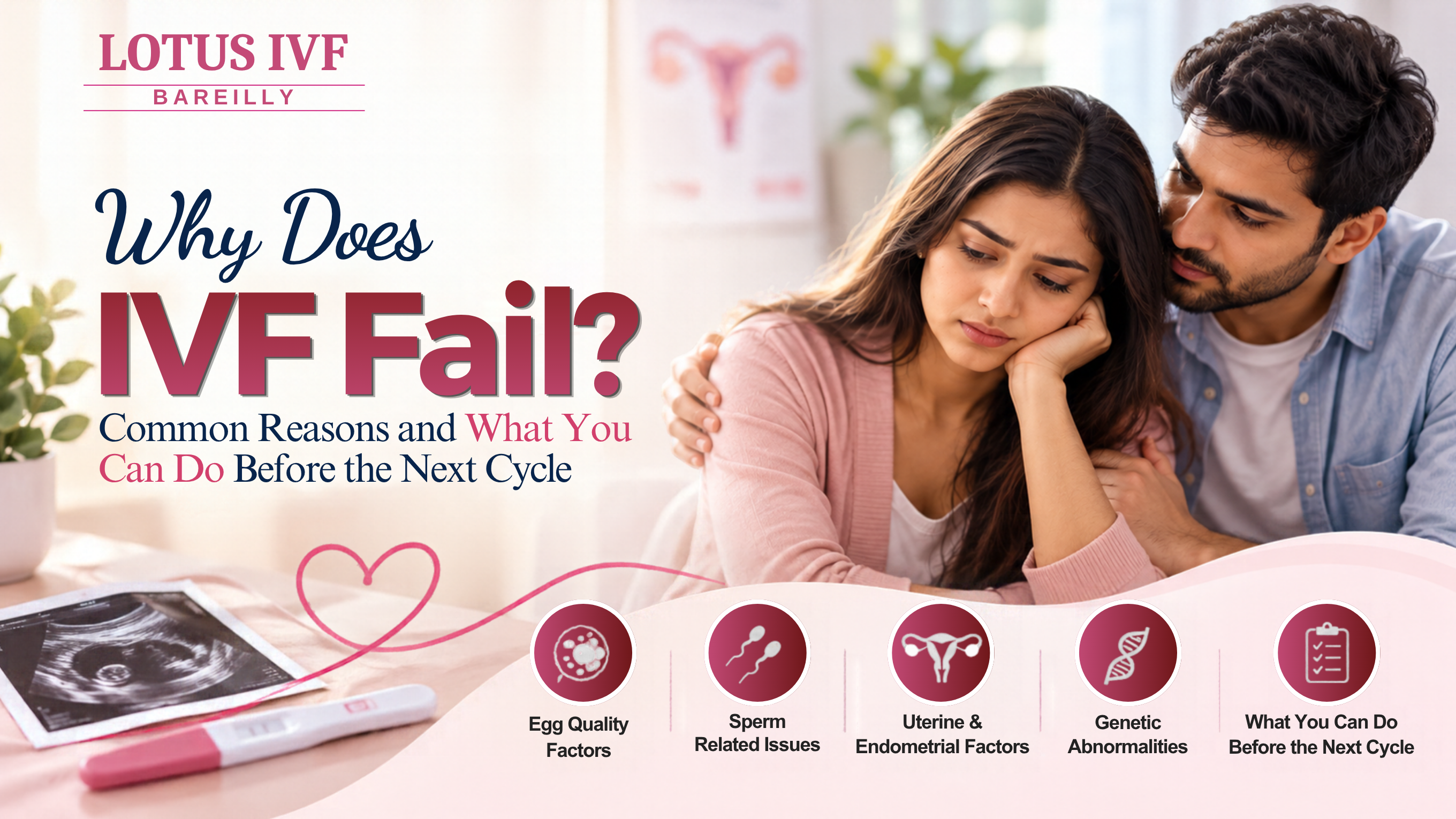 If your IVF cycle did not end in pregnancy, you may be feeling disappointed, exhausted and full of questions. An unsuccessful IVF cycle is not a judgment on your body, your effort or your future chances.
IVF has several stages: ovarian stimulation, egg retrieval, fertilization, embryo development and embryo transfer. Each must go well, and even with carefully managed treatment, pregnancy is never certain. That is why many couples ask, “Why does IVF fail?” The honest response is that there are many probable reasons, and occasionally none can be named. Below, we explain the common ones in plain language and what you can discuss with your fertility specialist before the next IVF cycle.
Why Does IVF Fail?
Typically, there is not one reason for an unsuccessful IVF. IVF success depends on a number of interrelated factors, including:
- Egg quality and age
- Embryo quality
- Sperm factors
- Uterine or endometrial factors
- Ovarian response
- Implantation
- Underlying medical or fertility conditions
These factors may contribute to IVF failure, but none of them definitely causes it in every case. A healthy-looking embryo may still not implant, and in many cycles the exact reason is never found. That doesn't mean that you did something incorrectly or that something was missed.
Common Reasons Why IVF May Not Work
Egg Quality and Age
Quality of eggs impacts fertilization, the development of the embryo and chromosomal make-up of the embryo. With advancing age in women, the ovarian reserve of women decreases and a larger proportion of eggs may have chromosomal abnormalities. Age plays a key role in the success rate of IVF procedure, but it is not a definitive road block for any individual patient.
Embryo Quality
The embryo should develop perfectly, implant, and continue developing. Embryo grading involves assessing an embryo according to its appearance under a microscope, and this enables the selection of embryos for transfer. This procedure is beneficial, yet it does not ensure that the embryo will attach or lead to a pregnancy.
Some embryos stop developing or fail to implant because of chromosomal changes. These are usually random events and are not caused by anything you did or did not do.
Sperm Quality
Sperm count, motility (movement) and morphology (shape) can influence fertilization and early embryo development. Male factors contribute to a significant share of fertility challenges, so looking at both partners is a sensible part of understanding an unsuccessful cycle. Where appropriate, a repeat semen analysis or other sperm evaluation may be discussed. This is about understanding, not blame.
Implantation Problems
A pregnancy transfer can be successful even if the embryo is not implanted. The embryo must affix itself to the uterine wall, while concurrently, the uterus must be open to it.This is a process that can fail even when everything appears to be normal.
Uterine or Endometrial Factors
Sometimes fibroids, polyps, adhesions or an inappropriate lining of the uterus might interfere with implantation. However, not all patients require thorough examinations of these conditions. Your doctor will make a decision based on your medical history and ultrasound findings.
Ovarian Response and Number of Eggs Retrieved
Ovaries react to the stimulation in their own way. Obtaining more eggs is not a necessary condition for a positive outcome of the procedure since it depends on the amount of mature and high-quality eggs and the quantity of healthy embryos. The lack of eggs does not mean that you cannot conceive. Normally, your physician considers your ovarian reaction to drugs.
Underlying Fertility or Medical Conditions
Some health issues including endometriosis, PCOS, problems with the thyroid gland or other hormones may affect your fertility treatment process. They do not always lead to unsuccessful treatment, since many patients with these conditions manage to conceive successfully.
Does a single unsuccessful IVF cycle indicate that IVF will never be successful?
No. A single failed attempt does not necessarily imply that future efforts will be unsuccessful. Your fertility expert might analyze the last cycle to comprehend:
- Ovarian response
- Number and maturity of eggs retrieved
- Fertilization results
- Embryo development and quality
- Endometrial preparation
- Embryo transfer
- Any relevant medical factors
Many couples go on to conceive after an unsuccessful first cycle, though outcomes vary and no one can promise a particular result. Future treatment ought to be personalized instead of a replication of the same method.. Sometimes small adjustments are suggested; sometimes the plan stays similar. Either way, the decision should come from your own cycle details.
What Actions Can You Take Prior to Your Upcoming IVF Cycle?
There is no formula that guarantees a different result, but a few practical steps can help you prepare and make the next conversation with your doctor more productive.
1. Review the Previous IVF Cycle
Going through the whole cycle with your fertility specialist, from stimulation to embryo transfer, can clarify what went well and what might be adjusted.
2. Discuss Any Recommended Tests
Depending on your history and previous outcome, your doctor may suggest additional investigations. These are not mandatory for everyone, so ask why a test is being recommended and how it could change your plan.
3. Focus on Overall Health
General health supports you through treatment, though no lifestyle change can guarantee IVF success. Consider:
- Balanced nutrition
- A healthy weight, where appropriate
- Regular physical activity
- Adequate sleep
- Avoiding smoking and tobacco
- Limiting alcohol
- Managing existing medical conditions
4. Review Medications and Supplements With Your Doctor
Please do not start or stop fertility medicines, vitamins or supplements without speaking to your fertility specialist first.
5. Give Emotional Well-Being Attention
A failed IVF attempt can be mentally challenging. Rely on your spouse or someone close to you, and seek professional help from a therapist when necessary. Psychological stress alone cannot lead to an IVF failure, so please do not put yourself through unnecessary suffering.
When Should You Consider Trying IVF Again?
There is no universal "waiting period" that will work for everyone. The correct duration depends on your age, health state, recovery process, ovarian stimulation, results of previous attempts, and your fertility expert’s evaluation. Some women are ready soon enough after the failed attempt, while others need some time to recover. Both approaches are equally fine. Talk about timing with your doctor.
Questions to Ask Your Fertility Specialist After IVF Failure
Questions to ask at your next consultation:
- What exactly happened in my previous IVF procedure?
- How did I respond to my ovarian stimulation?
- How many eggs have been retrieved and fertilized?
- How did my embryos develop?
- Did anything unusual happen during the embryo transfer?
- Do I need to conduct any further tests?
- Are there any changes to be made prior to the next IVF round?
- When should I try again?
Writing the answers down can help, especially when emotions run high during a consultation.
Final Thoughts
IVF failure can happen for many different reasons, and an unsuccessful cycle does not necessarily mean future treatment will fail. If you are still asking, “Why does IVF fail?” about your own cycle, the most useful answer comes from a careful review of your individual treatment history, not from general statistics or comparisons with others.
At Lotus IVF, Bareilly, couples can discuss their previous cycle with a fertility specialist and plan the next step based on their own medical circumstances. Whether you choose to continue with us or seek another opinion, give yourself time, ask questions, and move forward at your own pace. You are not alone in this.
This article is for general information and does not replace personalised medical advice. Please consult a qualified fertility specialist about your own situation.
Frequently Asked Questions
Q1.Why does IVF fail even when the embryo looks healthy?
Embryo grading shows only how an embryo looks, not its chromosomal health or how receptive the uterus is. So a good-quality embryo may still not implant.
Q2. Why does IVF fail in the first attempt?
Usually it is a combination of factors like egg quality, sperm factors, ovarian response and implantation. Many couples conceive in later cycles, but no outcome can be promised.
Q3. Is an unsuccessful IVF cycle anyone's fault?
No. Many embryos stop developing because of random chromosomal changes, which are not caused by anything either partner did.
Q4. Does stress cause IVF failure?
Stress alone is not known to directly cause IVF failure. Still, emotional support from your partner or a counsellor can help during treatment.
Q5. What tests may be needed before the next IVF cycle?
It depends on your history and previous cycle. Your fertility specialist will advise, and tests are not required for everyone.